Abstract
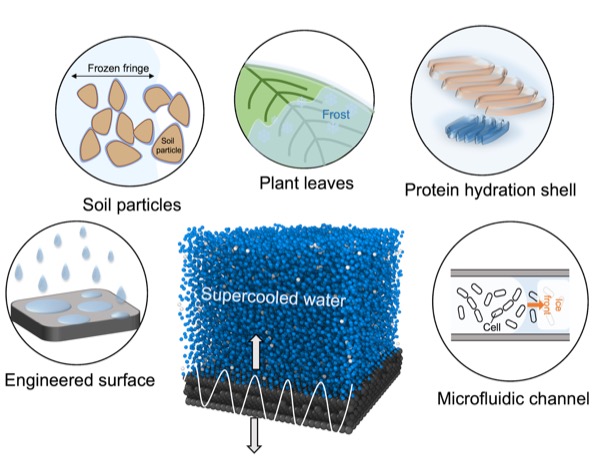
Suppressing ice nucleation in interfacial water nanofilms is critical for preventing macroscopic icing in a wide range of natural and engineered systems. Surface vibrations have been proposed as a promising, energy-efficient anti-icing strategy, yet the molecular mechanisms by which surface vibrations inhibit ice nucleation remain poorly understood. Here, we use molecular dynamics simulations to investigate how harmonic surface vibrations influence heterogeneous ice nucleation in supercooled water nanofilms. We identify two distinct and complementary mechanisms. First, surface vibrations induce acoustothermal heating in the adjacent liquid, reducing the degree of supercooling and thereby lowering nucleation rates. Beyond this thermal effect, we uncover a separate (non-thermal) kinetic mechanism: surface vibrations disrupt the interfacial water structure by increasing molecular mobility and dispersing the spatial arrangement of water molecules near the surface, thereby hindering the formation of stable pre-nucleation structures. Vibrations significantly reduce nucleation rates, indicating that kinetic disruption alone can suppress freezing even when liquid temperature is held constant. Direct structural analysis confirms this kinetic mechanism: both the population of ice-like clusters and the tetrahedral order of interfacial water decrease under vibration. By mapping vibration-induced structural changes onto an effective surface temperature, we show that relatively small reductions in interfacial water density correspond to substantial increases in the free-energy barrier for nucleation near the freezing limit. These results provide molecular-level insight into vibration-mediated control of ice formation and highlight surface vibrations as a powerful strategy for suppressing ice nucleation at its nanoscale origin.