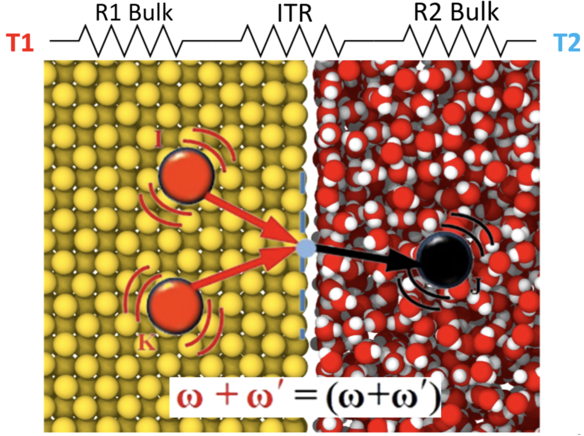
Depiction of inelastic phonon transmission at gold/water interface with corresponding resistors (including ITR) shown above.
Interfacial Thermal Resistance at Solid/Liquid Interfaces (2020-)

Increasing transistor densities and on-chip clockspeeds have yielded increasing thermal loads on modern integrated circuits (ICs), leading to a severe degradation in their performance. These higher thermal loads have spurred interest in two-phase cooling devices, where the objective has been to exploit and optimise the latent heat of vapourisation of the working fluid, thus extracting a significantly greater amount of heat from ICs. The performance of such devices is dictated by how efficiently heat can be transported across the solid/liquid and liquid/vapour interfaces. The interfacial thermal resistance (ITR) strongly influences the mechanisms by which heat is transferred at such interfaces and is therefore key to optimising the performance of these devices. The underlying mechanisms that lead to ITR have yet to be fully understood; existing literature attributes ITR to the the mismatch in the electronic and vibrational spectra of the materials forming the interface, which does not always hold.

The goal of this project is to gain a deeper understanding of the nanoscale physics involved and the role of surface characteristics in manipulating these physical phenomena to minimise ITR.
Researcher(s) involved: Abdullah and Rohit.

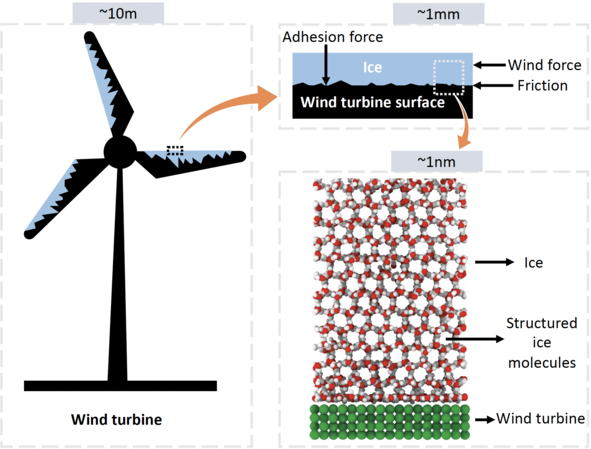
Macroscale ice adhesion to wind turbnes (left), microscale interface between wind turbine blade and ice (top right), nanoscale view of interface (bottom right).
Understanding Ice Adhesion at the Nanoscale (2022-)

Ice formation and accretion on surfaces can severely damage infrastructures such as highways, dams, and buildings or shorten their service lives; reduce the energy efficiency of wind turbines, and hinder the operational performance of instrumentation on aircraft, ships, and helicopters. In daily life in the winter, the icing on the pavement results in countless accidents that can potentially lead to a loss of life. Traditional de-icing methods include mechanical removal, surface-heating, and spraying chemicals. While mechanical and heating are energy-consuming, the chemicals are proven to be detrimental to the environment. Therefore, new de-icing methods, such as fabricating anti-icing surfaces, are expected to be developed to efficiently hinder ice formation. To achieve this, the underpinning physics of the ice adhesion needs to be better understood, whereby the ice adhesion strength on a substrate can be reduced and the ice can be effectively removed.

Researcher(s) involved: Pengxu, Saikat, and Rohit.

Related Papers

Ionic adsorption on bulk nanobubble interfaces and its uncertain role in diffusive stability

Dockar et al. J. Colloid Interface Sci. 2025

Spectral mechanisms of solid/liquid interfacial heat transfer in the presence of a meniscus

El-Rifai et al. Phys. Chem. Chem. Phys. 2025

Contaminant Removal Using Vibrating Surfaces: Nanoscale Insights and a Universal Scaling Law

Pillai et al. Nano Lett. 2025

Unraveling the Regimes of Interfacial Thermal Conductance at a Solid/Liquid Interface

El-Rifai et al. J. Phys. Chem. C 2024

Thermal Oscillations of Nanobubbles

Dockar et al. Nano Lett 2023

Rolling and Sliding Modes of Nanodroplet Spreading: Molecular Simulations and a Continuum Approach

Perumanath et al. Phys. Rev. Lett. 2023

Contaminant Removal from Nature's Self-Cleaning Surfaces

Perumanath et al. Nano Lett. 2023

A weighted particle scheme for Enskog-Vlasov equation to simulate spherical nano-droplets/bubbles

Busuioc et al. J. Comput. Phys. 2023

Inertio-thermal vapour bubble growth

P. Sullivan et al. JFM 2022

Impact of surface nanostructure and wettability on interfacial ice physics

Nikiforidis et al. J of Chem. Phys. 2021

Acoustothermal Nucleation of Surface Nanobubbles

Datta et al. Nano Letters 2021

Molecular physics of jumping nanodroplets

Perumanath et al. Nanoscale 2020

Rarefied flow separation in microchannel with bends

Ho et al. J. Fluid Mech. 2020

Departure Velocity of Rolling Droplet Jumping

Shaokang et al. Langmuir 2020

Droplet jumping induced by coalescence of a moving droplet and a staticone: Effect of initial velocity

Li et al. Chem. Eng. Sci. 2019

Bubble formation in freezing droplets

Li et al. Phys. Rev. Fluids 2019

Droplet Coalescence is Initiated by Thermal Motion

Perumanath et al. Phys. Rev. Lett. 2019

Acoustothermal Atomization of Water Nanofilms

Pillai et al. Phys. Rev. Lett. 2018

Dynamics of Nanodroplets on Vibrating Surfaces

Pillai et al. Langmuir 2018