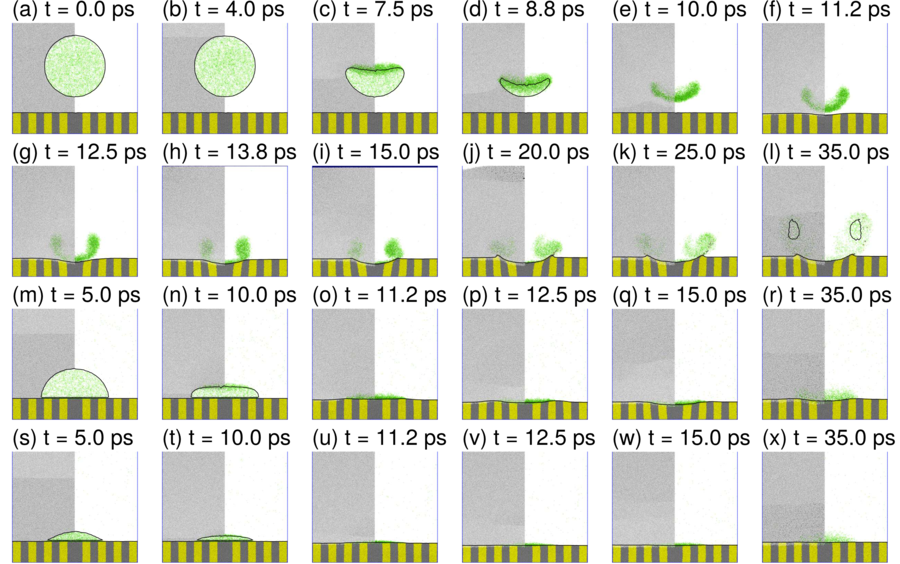
Comparison of (a)–(l) 40nm spherical nanobubble, (m)–(r) high contact angle (HCA) surface nanobubble, and (s)–(x) low contact angle (LCA) surface nanobubble, collapsing near a amorhpous silicon substrate.
Nanobubble Cavitation Dynamics (2016-)

Nanobubbles are being applied in cancer treatment, surface cleaning, sonochemistry, and water treatment, for break-down and removal of particles/cells and enhanced chemical reactions. Central to these applications is their cavitation dynamics, or how they respond under rapid variations in pressure, for example under ultrasound irradiation. Conventional cavitation models for macroscale bubbles typically fail at the nanoscale due to heterogeneous surface pinning effects, high-density non-ideal gas behaviour, rarefied gas dynamics, and other atomic-level phenomena. In this research, we investigate the suitability of these classical models for pinned surface nanobubbles and bulk nanobubbles, and derive new theoretical models to explain their often anomalous behaviour.

This work is being conducted by Duncan.

Academic(s) involved: Livio.
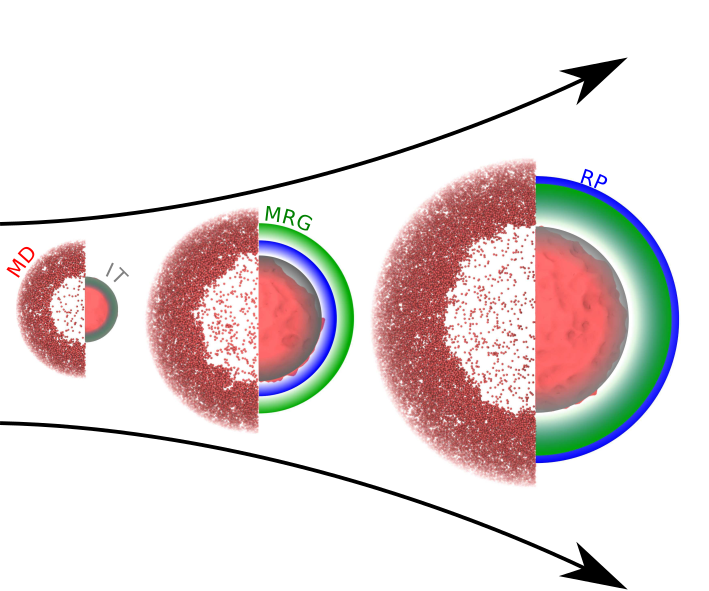
Comparison of Inertio-Thermal (IT) model predictions with the inertial Rayleigh-Plesset equation (RP), the MRG model, and MD results.
Inertio-Thermal Vapor Bubble Growth (2019-)

Our understanding of vapour bubble growth is currently restricted to asymptotic descriptions of their limiting behaviour. While attempts have been made to incorporate both the inertial and thermal limits into bubble growth models, the early stages of bubble growth have not been captured. This project accounts for both the changing inertial driving force and the thermal restriction to growth, and aims to develop inertio-thermal models of homogeneous/heterogeneous vapour bubble growth, capable of accurately capturing the evolution of a bubble from the nano- to the macro-scale. Model predictions are validated against: a) published experimental and numerical data, and b) our own molecular simulations. This has potential application in improving the performance of engineering devices, such as ultrasonic cleaning and microprocessor cooling, as well as in understanding of natural phenomena involving vapour bubble growth.

This work is being conducted by Patrick.

Academic(s) involved: Rohit.

Related Papers

Nanoscale insights into vibration-induced heterogeneous ice nucleation

Chen et al. Nanoscale 2025

Nanoscale surface effects on heterogeneous vapor bubble nucleation

Sullivan et al. J. Chem. Phys. 2025

Ionic adsorption on bulk nanobubble interfaces and its uncertain role in diffusive stability

Dockar et al. J. Colloid Interface Sci. 2025

Thermal Oscillations of Nanobubbles

Dockar et al. Nano Lett 2023

The role of surface wettability on the growth of vapour bubbles

P. Sullivan et al. IJHMT 2023

A weighted particle scheme for Enskog-Vlasov equation to simulate spherical nano-droplets/bubbles

Busuioc et al. J. Comput. Phys. 2023

Inertio-thermal vapour bubble growth

P. Sullivan et al. JFM 2022

Impact of surface nanostructure and wettability on interfacial ice physics

Nikiforidis et al. J of Chem. Phys. 2021

Shock-induced collapse of surface nanobubbles

Dockar et al. Soft Matter 2021

Acoustothermal Nucleation of Surface Nanobubbles

Datta et al. Nano Letters 2021

Forced oscillation dynamics of surface nanobubbles

Dockar et al. J. Chem. Phys. 2020

Mean-field kinetic theory approach to Langmuir evaporation of polyatomic liquids

Busuioc et al. Phys. Fluids 2020

A relaxed multi-direct-forcing immersed boundary-cascaded lattice Boltzmann method accelerated on GPU

Zhang et al. Comput. Phys. Commun. 2020

Bubble formation in freezing droplets

Li et al. Phys. Rev. Fluids 2019

Mechanical Stability of Surface Nanobubbles

Dockar et al. Langmuir 2019