Adsorption and transport in organic shale kerogen (2018-)

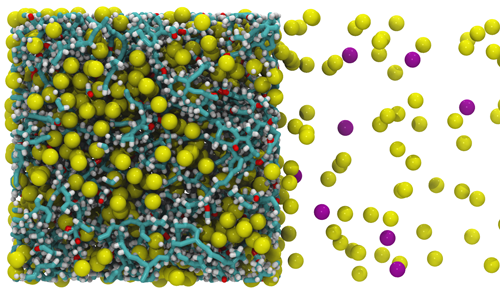
Owing to the heterogeneous geological conditions of unconventional reservoirs and the complexity of adsorption and transport at multiple-scales, the production of shale gas is far from that being accurately forecast. Micropores (< 2 nm) and macropores (< 50 nm) are responsible for the majority of methane adsorption inside reservoirs. Due to the nanoscale confinement and the high underground pressures and temperature, it is also challenging to predict the fluid transport. In this work we have developed new models for adsorption and transport in and through realistic kerogen samples, using molecular simulations.

This work is funded by partners from King Fahd University of Petroleum and Minerals (KFUPM), and involves the following researchers (Carlos, Qiang, Runxi, Saikat, and Yichong).

Related Papers

Volume diffusion modelling of a sheared granular gas

Dockar et al. arXiv 2024

Methane scattering on porous kerogen surfaces and its impact on mesopore transport in shale

Chen et al. Fuel 2022

Untangling the physics of water transport in boron nitride nanotubes

Mistry et al. Nanoscale 2021

Self-diffusivity of dense confined fluids

Corral-Casas et al. J of Chem. Phys. 2021

Shale gas permeability upscaling from the pore-scale

Germanou et al. Phys. Fluids 2020

Dense gas flow simulations in ultra-tight confinement

Sheng et al. Phys. Fluids 2020

Enhanced nanoparticle rejection in aligned boron nitride nanotube membranes

Casanova et al. Nanoscale 2020

GSIS: An efficient and accurate numerical method to obtain the apparent gas permeability of porous media

Su et al. Comput. Fluids 2020

Surface-Controlled Water Flow in Nanotube Membranes

Casanova et al. ACS Appl. Mater. Interfaces 2019

Pore-scale simulations of rarefied gas flows in ultra-tight porous media

Ho et al. Fuel 2019

A multi-level parallel solver for rarefied gas flows in porous media

Ho et al. Fuel 2019