When Bubbles Bite
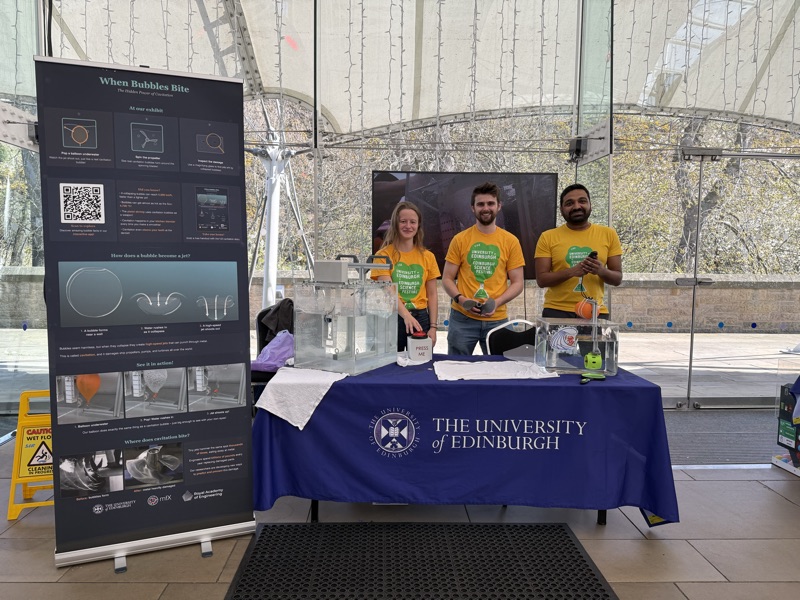
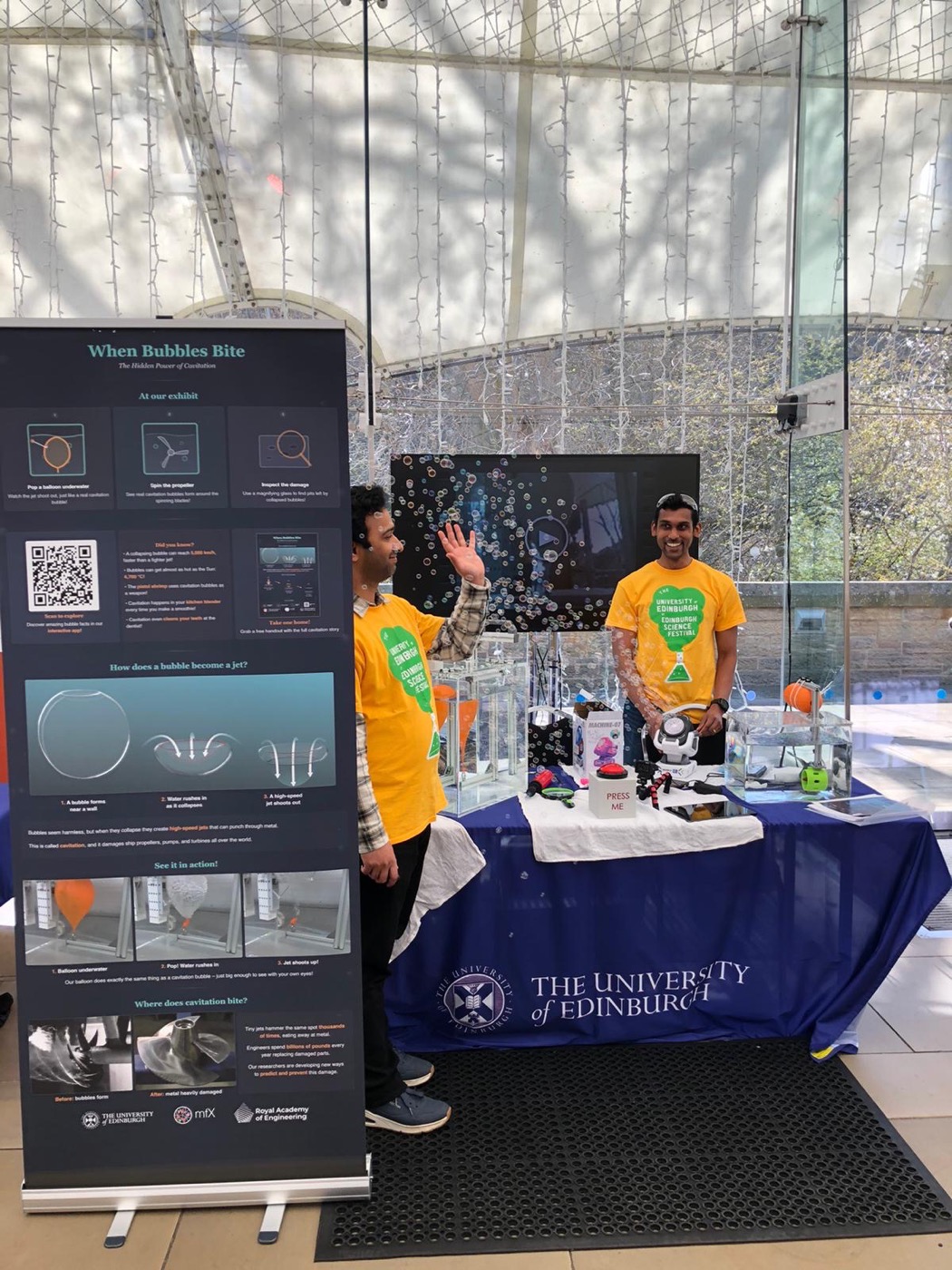
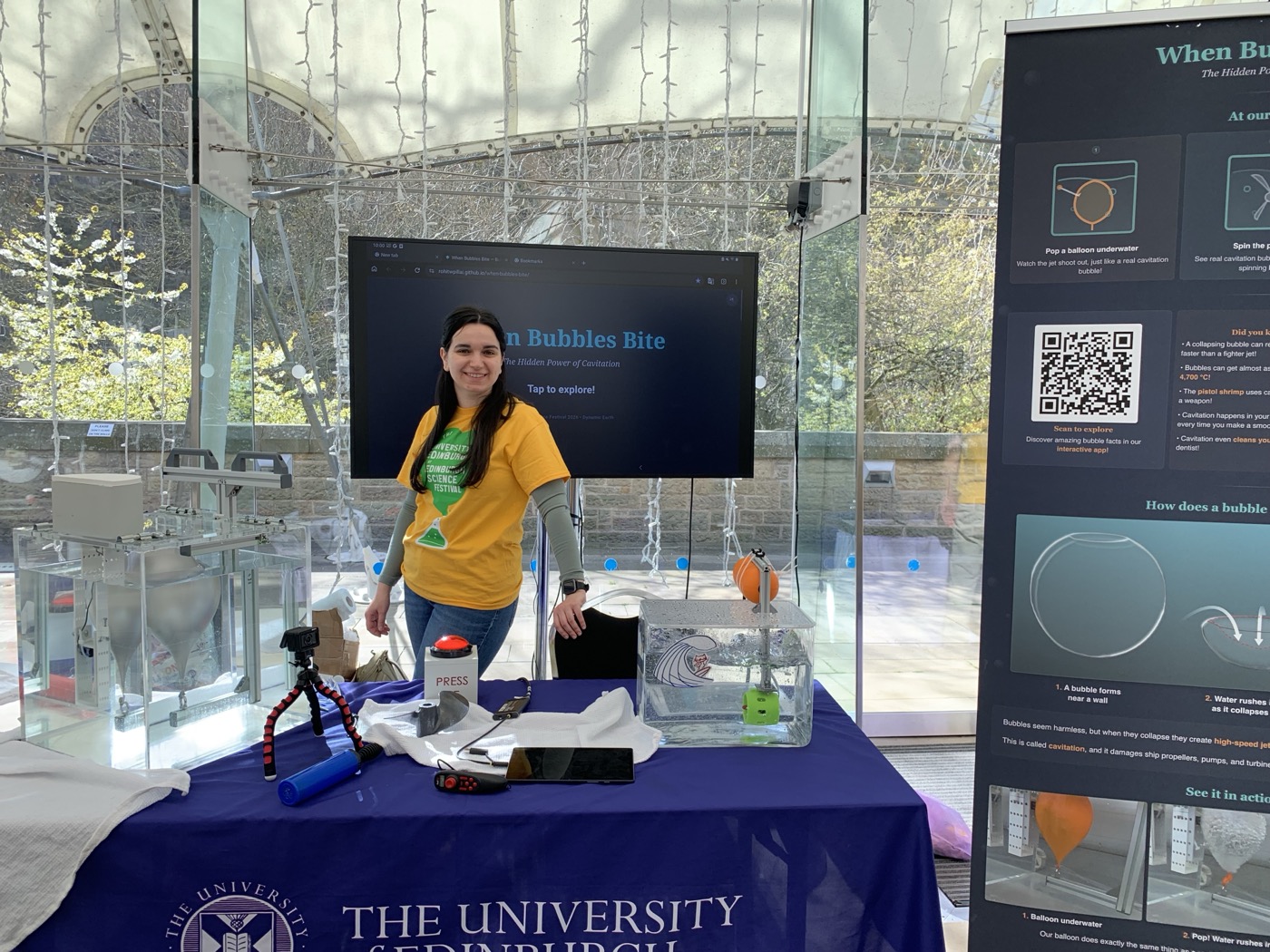
"When Bubbles Bite" is our interactive exhibit about cavitation: how collapsing bubbles grow teeth sharp enough to chew through ship propellers. It debuted at the Edinburgh Science Festival 2026 (Dynamic Earth, 10–13 April), where it was competitively selected for the festival programme, and was presented at the Practical Engineering Education Conference (PEE26) in July 2026.
At the exhibit
See it in action
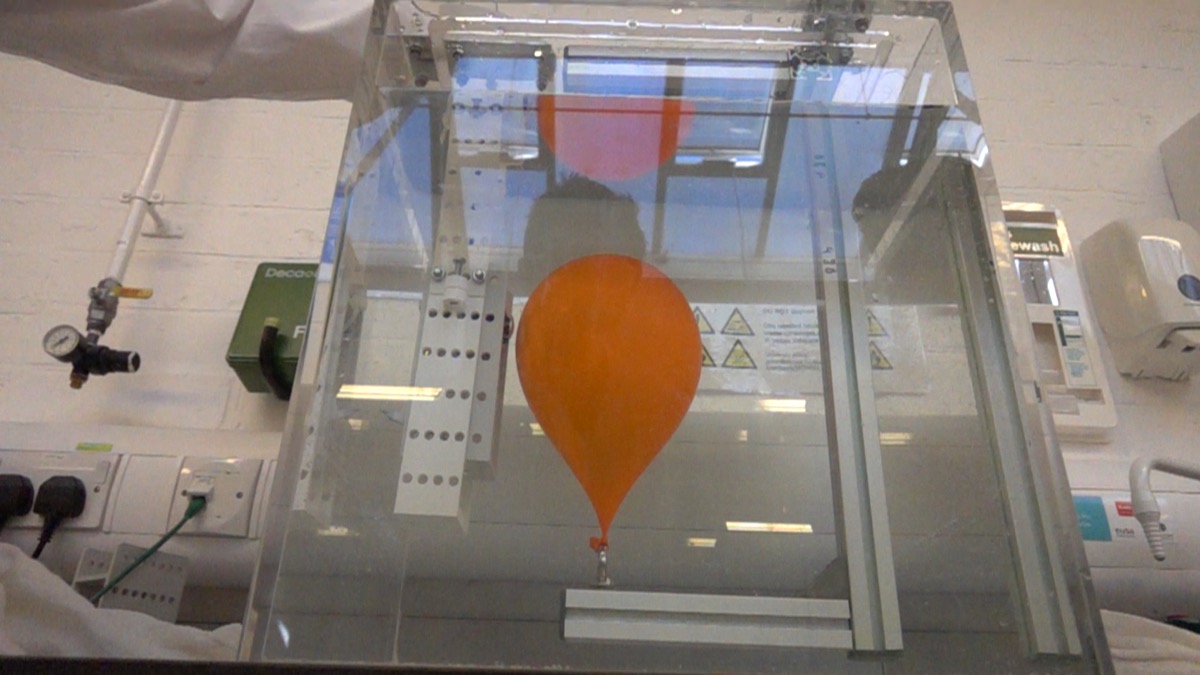
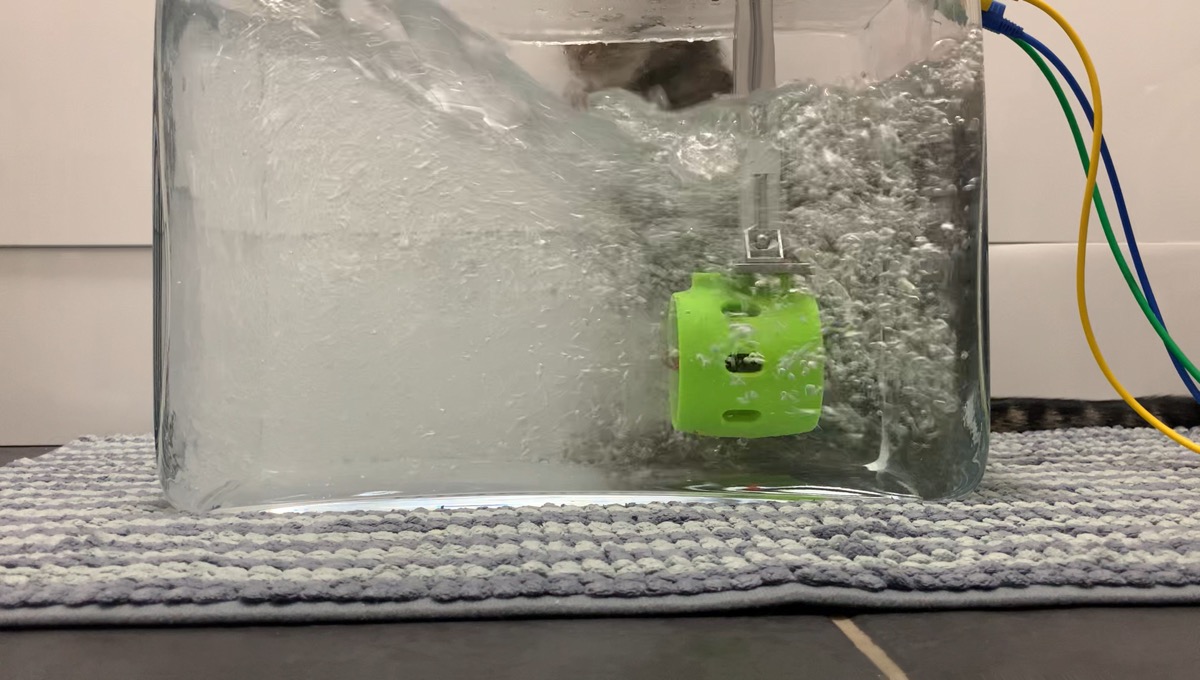
A burst at the stand: the needle punctures the balloon and the inrushing water collapses the cavity into a jet. Visitors watched each burst live, then again in slow motion. The same jetting is what lets cavitation bubbles "bite" into ship propellers.
The science
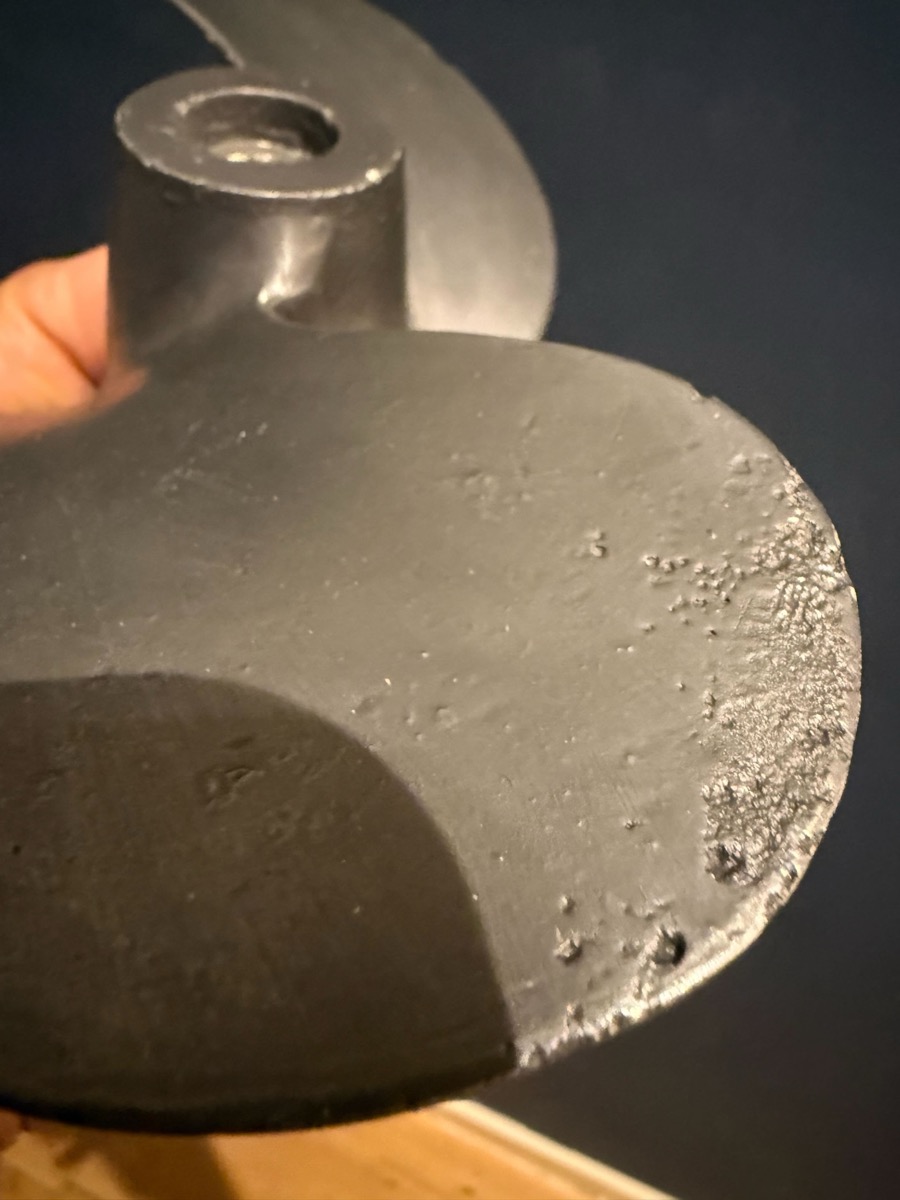
Cavitation bubbles form wherever fast-moving liquid drops below its vapour pressure, on spinning propeller blades, in pumps and turbines, even in your kitchen blender. The damage comes from their collapse. If the pressure around a bubble were perfectly uniform, it would implode symmetrically, radiating shock waves. In reality there is almost always an asymmetry: a nearby wall, a pressure gradient, or simply gravity. Liquid on the high-pressure side accelerates inward faster, penetrates the collapsing bubble, and emerges as a narrow high-speed jet directed at the low-pressure side, which is usually the surface the bubble formed on.
These jets have been measured at hundreds of metres per second, approaching the speed of sound in water. Each impact is strong enough to plastically deform metal, and repeated impacts hammer the same spots thousands of times, eating away at pump blades and propellers through pitting, erosion and fatigue. Engineers spend billions of pounds every year replacing cavitation-damaged parts. Yet a real cavitation bubble is around a hundredth of a millimetre across and collapses in about ten millionths of a second, far too small and too fast to see, which is why the phenomenon is so widely misunderstood. The same physics can also be exploited, from ultrasonic cleaning of surfaces (and teeth) to targeting disease with microbubbles, and understanding and controlling bubble nucleation, growth and collapse is one of the mfX group's core research themes.
Our balloon is a scaled analogue of that invisible bubble. At this size the collapse is driven by gravity: the water pressure at the bottom of the balloon is higher than at the top, and cavitation theory shows that a gravity-driven pressure gradient produces the same jet structures as a nearby solid surface. The bursts at our tank collapse in roughly a fifth of a second, four orders of magnitude slower than a real cavitation bubble and resolvable with a high-speed camera, and every measured burst sits in the strong-jet regime of the theory, forming the same directed jet and ring vortex as a microscopic cavitation bubble.
The mechanism
The bursting rig was designed, built and tested by Clara Stirling as her BEng final-year project, supervised by Rohit Pillai and Duncan Dockar. Visitors trigger each burst from a 3D-printed actuation box with an engraved "Press Me" instruction; the button press is transmitted over Bluetooth to a second circuit at the tank, where an Arduino controls a waterproof servo mounted on a height-adjustable 3D-printed strut. On actuation, the servo rotates a needle-tipped arm through an arc to burst the submerged balloon, then returns it to a protected neutral position. The two-circuit wireless architecture keeps all electronics except the sealed servo above the waterline.
Run by mfX volunteers: Jacqui, Brian, Tushar, Abhinav, Yuanye, Taher, Rachel, Janice, Clara, and our mechanised assistant Chonky Walter.
Supported by the University of Edinburgh, Multiscale Flow X, and the Royal Academy of Engineering.